
How architect Geoffrey Bawa’s work inspired Eraeliya Villas & Gardens
Written By: Zinara Rathnayake (South Asia Chair for World’s 50 Best Hotels)
Take a trip through Sri Lanka, and you’ll realise how design and architecture fuse seamlessly with the environment that surrounds our local buildings. Sunlight dapples through the open courtyards that are central to heritage homes; terracotta tiles crown the roof; browned earthen floors soak up the scorching heat; and dried palmyrah fronds – often used as fencing material – guard local homes in the island’s North. It’s also these principles that the late Geoffrey Bawa, Sri Lanka’s most celebrated architect, mirrored through his designs.
Although the architect is often called the ‘Father of Tropical Modernism,’ Bawa himself never used the term. His designs, however, marked a shift from the international modernist architecture that was popular in the middle decades of the 20th century. Bawa’s design philosophy responded to the movement of light and air, as well as changes in weather, while incorporating local materials and indigenous building practices. His country estate Lunuganga – once an abandoned rubber plantation on the banks of Dedduwa Lake near Bentota – became a place for Bawa to test and develop spatial and landscape design methods. In Eraeliya, too, you’ll find our rooms and gardens influenced by Geoffrey Bawa’s architectural legacy.
Living with nature at Eraeliya
Be it the beachfront hotel in Bentota with a central courtyard peppered with frangipani islands or the Kandalama hotel that sinks into the dense jungle, Bawa’s work was informed by a strong sense of place. At Eraeliya, the interiors and gardens similarly capture the soul and spirit of the setting. The spaces within merge effortlessly with the ocean and tropical jungle that surrounds our villas.
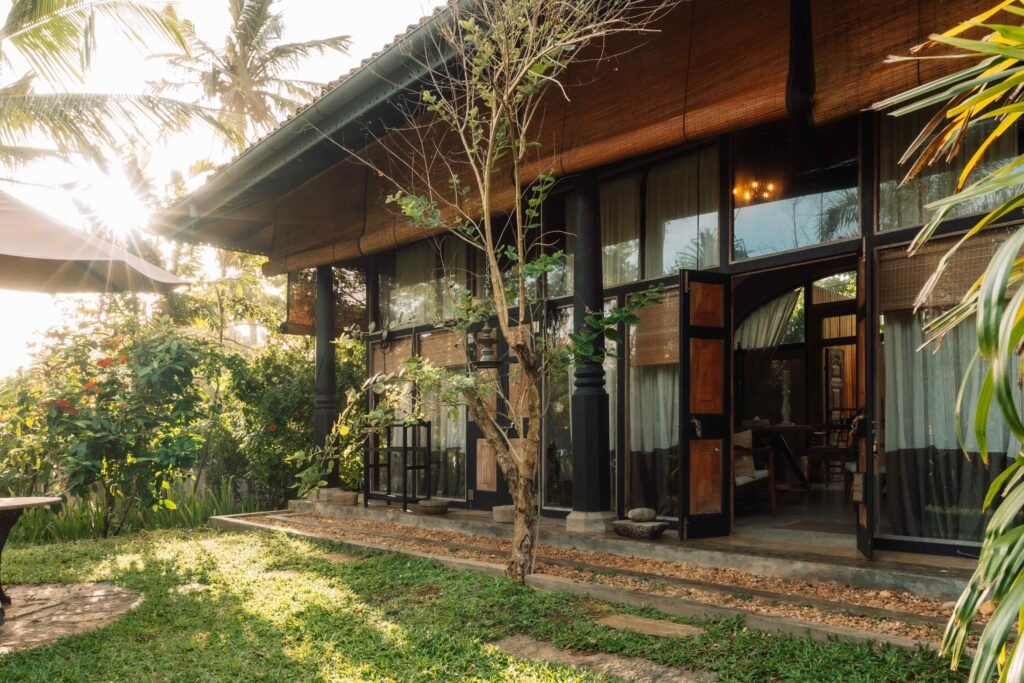
Take, for example, Villa Walauwa, a beautifully restored, clay-roofed ancient Sri Lankan home, which sits below a tree canopy. The spacious, open veranda is integral to the living at Walauwa, and overlooks the coconut-fringed bay and the endless expanse of the Indian Ocean. A long dining table sits at the centre, perfect to linger over slow dinners as waves gently lap the shore and coconut palms sway in the night’s breeze.
The idea was to invite guests to connect with the tropics, the manicured gardens, and the constantly evolving life of the coast. Other guest accommodations, like the Ambalama Pavilion, are integrated into the flowering garden. And of course, you’ll love the opportunity to shower under the stars at night as bright red heliconia drops down the open-to-sky bathroom walls.
The space within, and beyond
Another key principle you will notice in Bawa’s work is how the architect creates spaces that blur the margins between inside and outside. Take, for example, Bawa’s urban home No.11, which he built in a cul de sac in cosmopolitan Colombo. Light wells bring abundant sunlight; a wooden latticework gate leads to his garage; and a frangipani tree sits in the rear courtyard. Doors open to passageways and give way to another door.
This fluidity is central to the living and sleeping spaces at Eraeliya, where the natural movement of light and air is given prominence. Guests arrive at the reception, located in the living room within our main house (Villa Bawana) with large windows, lofty ceilings, and open-plan layouts. A long corridor with artwork leads the way to the villa’s back door, which opens to poolside patios. The high columns before the infinity pool and their strict symmetry draw from the Palladian architectural influences, a classic European design style with its roots tied to the Italian architect Andrea Palladio in the 16th century.
Upstairs, glass doors open to terraces that overlook the palm-framed ocean. Rooms and design-led lofts connect to verandas in the garden. Everywhere you look, interiors and exteriors merge and transition with one another.
A personal story
What makes Eraeliya truly remarkable, however, is how intimate and personal it is. As you walk past the main gate, through the lily pond, into our lush garden and living areas, Ereliya soon unravels a deeply personal story. One that is envisioned by our founder and curator, Nyuri Egorkina, an interior designer who fell in love with the magical island and its slow rhythm of life.
You’ll soon come to know that Eraeliya’s tidied villas and gardens are far from your conventional beach resort. It’s a home well-loved, somewhere that feels lived in and rooted in the island’s centuries-old culture. Here, lotuses bloom, ferns thrive in unassuming nooks, and hand mudra (a meditative symbol in Buddhism) knobs from Nepal replace typical door locks.
In many ways, Eraeliya feels like a well-curated gallery of sorts where bright paintings line narrow passageways, and detailed interiors fill each room with its own personality and character. Most of what you see at Eraeliya, in fact, are collectibles Nyuri handpicked during her travels across the globe. Some of our suites, you’ll notice, feature massive bathtubs carved out of a single slab of rock, sourced from the ethereal Indonesian island of Bali.
At Eraeliya, the villas, gardens, lounges and patios are a nod to Geoffrey Bawa’s tropical modernist design principles. As you stay with us, you’ll unravel each layer, where art and architecture blend into the island life.